This is not a discussion on the reserve pilot chute.
What is used to extract the pin, and d-bag, from the main pack tray.
Material
F-111
In theory, it provides less oscillation during deployment. Consider if you only do hop&pops or are already flying a very large wingsuit.
ZP
ZP (Zero Porosity) provides quicker extraction during deployment. As the material wears, it will start to function like F-111. Has ~2x the lifespan of an F-111 pilot chute.
Handle
Plastic (PVC) Handle
The default/free handle. Typically bright orange.
Free-fly Pud
The most common handle for new containers. Low profile. In the shape of a triangular prism. Note: You do not grab these as expected - rather you cup your hand long-ways like so.
Hackey/Monkey Fist
A round ball. Hackeys are made with leather, while paracord is used for monkey fists.
Pull-out Pad
A flat, rectangular pad, only seen on pull-out systems.
Handle Tuck Tabs
Highly recommended. Required to free-fly. They significantly lower the chance that your handle will come loose when in the plane/sky. Have yet to see a good reason to get none or 2. The tuck tab will slide into a pocket beside the BOC (or a partitioned bridle channel). If you're afraid that you won't be able to deploy, just practice on the ground first.
Bridle Length
The length of your bridle should be just long enough for it to extend outside of your burble. Wingsuitters will use a longer bridle, as they have more surface area, and therefore a larger burble. The downsides of getting a longer bridle for non-wingsuitters are packing annoyance (as with most WS options), and more bridle flapping around in the wind at risk of entanglement/knotting.
Size
The size of your pilot chute determines the pull force on your packjob. Smaller canopies/containers will use a smaller pilot chute (for example).
The fabric of your pilot chute also can influence the size, since ZP is less porous than F-111. Regardless, either measure your container's current PC if replacing, or ask the manufacturer what size they recommend.
Kill-line
Also known as centerline
Made from Spectra, it will shrink over time. This is also why you will need to re-mark/color the window on your bridle over time.
Non-collapsible
Made just for student setups, these will leave the pilot chute inflated after opening. The benefit being that they do not need to be re-cocked after every jump.
Is it cocked?
Look inside the pilot chute. If the center tape is taught, while the kill-line is loose, then it is cocked.
Pull-out System
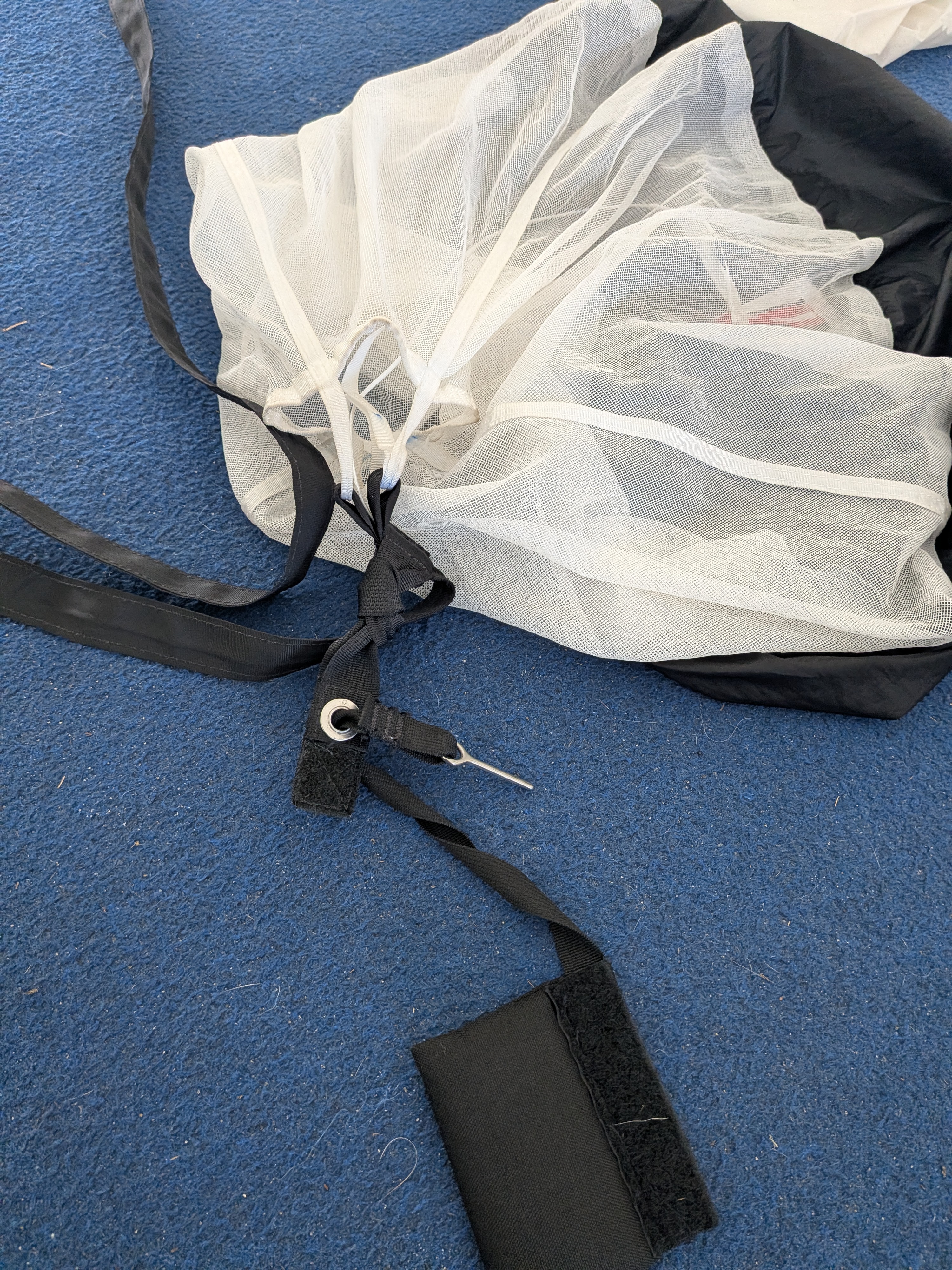
Almost all pilot chute systems today are throw-out. Pull-out systems are extremely different:
- Straight, instead of curved pin
- Handle is attached to the bridle, instead of PC
- PC is packed inside the container, instead of BOC
- This means no BOC pouch.
- Different deployment sequence
Tradeoffs
The benefit of fully protecting your PC from accidentally catching air from mid-air contact comes with some additional considerations:
- Unfamiliar to newer packers
- Longer to pack (requires more care)
Historical
Spring Pilot Chutes
Replaced by the more aesthetic throw-out system instead.
Learn More
Videos
- UPT: Get Geared Up
- UPT: Deploying with a Tuck Tab
- Colin Scott Thomson: The Pilot Chute Part 1 | 2